In January, Las Vegas became an amazing spot for CES 2026, the world’s largest tech event where more than 4,000 companies exhibited their innovations. This year’s exhibition was all about how creatively artificial intelligence can be applied in diverse fields, regardless of how small or big the idea was. One of the notable moments would be the speech delivered by Jensen Huang, founder and CEO of Nvidia, who framed the show’s theme as physical AI. Physical AI is the concept of robots embedded with artificial intelligence, enabling machines to perceive and interact with the physical environment. As highlighted in his speech, the exhibits were full of broad applications of physical AI, including smart homes, digital health, and all the other technologies that shape how we live and work.
Yet, the highlight of CES came from Boston Dynamics, which showcased its humanoid robot Atlas. Atlas is designed to assist industrial workloads, and is featured by its human-like motion. Hyundai, which possesses Boston Dynamics, shared its plan to begin deploying Atlas in factories by 2028.
However, CES wasn’t all about serious robots for industrial work. As you move through the event, you’ll likely find yourself amazed by some of the most playful and quirky technologies designed for everyday life. Here’s just a tiny glimpse of CES.
LEGO Smart Bricks:
Your LEGO set can feel you playing.

LEGO created a new interactive play system called Smart Bricks, which are LEGO pieces embedded with sensors, lights, and sound. In demonstration sets, including Star Wars kits, models reacted to the individual’s movement and placement. As you move one figure to another, ships start to light up and each scene triggers sound effects. Now, our imaginative play can be expanded with realistic depth.
Roborock Saros Rover Stair-Climbing Vacuum:
Vacuum cleaners, but they climb up the stairs.

Roborock solved the crucial limitation of vacuums, which are stairs. The Saros Rover uses articulated wheel-legs that lift the device upward, enabling it to clean across multiple floors without human assistance. This robot solved the mobility problem of home robots.
GE Profile Smart Fridge with Inventory Tracking:
Your fridge is now an inventory. Store food to earn recipes!
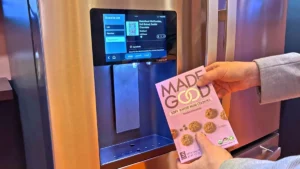
GE Profile introduced a refrigerator that has interior cameras with barcode scanning function to store information of all the ingredients inside the refrigerator. Through this application, users can see what’s inside, receive alerts for expiring food, and get recipe suggestions based on available ingredients inside the fridge. This feature simplifies meal planning and allows effective ingredient maintenance.
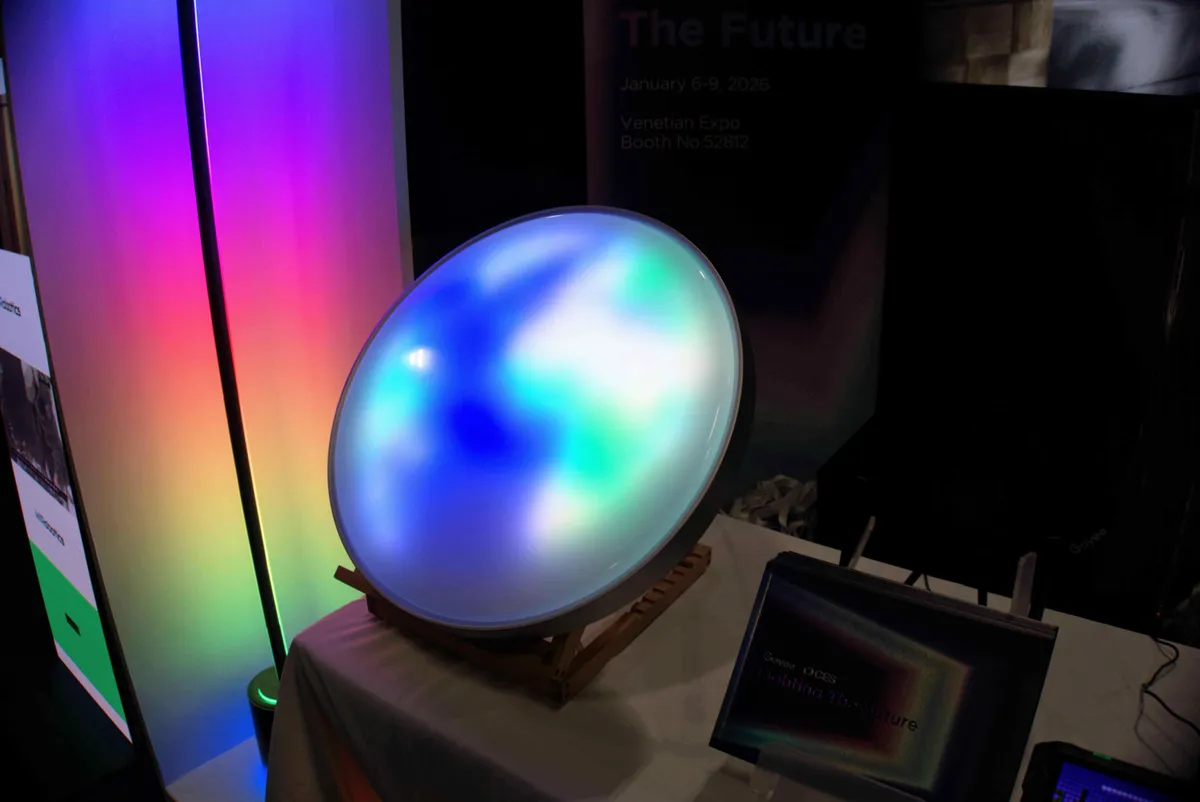
Govee Ceiling Light Ultra:
Ceiling light that mimics natural skylight.

Govee’s Ceiling Light Ultra uses a dense LED matrix to simulate skylight. Even in windowless rooms, the effect of this ceiling light resembles natural light and changing skies. For those who don’t enjoy artificial lighting, this ceiling light is a great option to set up the daylight. It has up to a 5000 lumen brightness and easily covers the large room. Its customizable characteristic also makes the art piece special.
Vocci AI Note-Taking Ring:
Organize and remember your daily conversations.
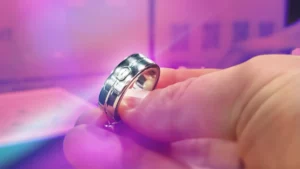
This ring records audio when a user taps, and then it transcribes and summarizes conversations into organized notes. If you want to mark a specific moment in a meeting, you can easily tap the button on the ring and the embedded AI will provide insight onto the note. Surprisingly, the ring supports more than 100 languages and can record for about 8 hours.
At CES 2026, many realized that the future of artificial intelligence is making everyday life more colorful and responsive. Rather than remaining confined in labs and data centers, AI is continuously weaving itself into ordinary objects that shape our daily lives. All these advancements heighten our curiosity about what might come next at CES 2027: perhaps a flying LEGO Death Star.