Have you ever thought you could calculate π by dropping needles on the floor? What about discovering that in a small classroom, there is a high chance of two people sharing the same birthday? Mathematics is often seen as predictable and calculation-heavy for students, but it actually contains a lot of surprises. More than often, it feels like math is closer to magic rather than logic. To me, math presents new perspectives in understanding the world, and it has a pure beauty inside it. Math is way more fascinating than it first appears, so why don’t we delve deeper into the strange nature of math?
1. Buffon’s Needle
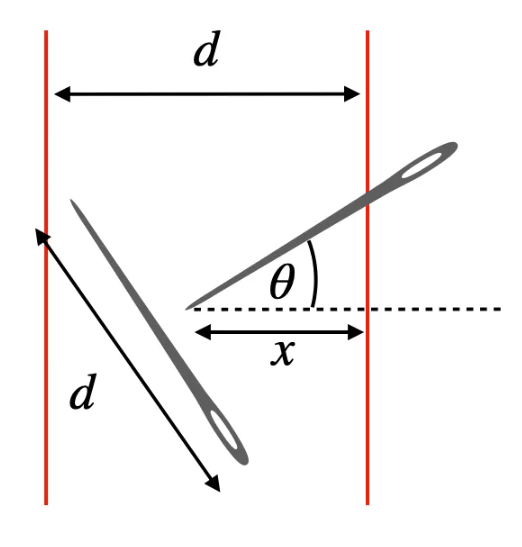
One of the most mind-blowing examples is Buffon’s Needle. This experiment was proposed by Georges-Louis Leclerc, Comte de Buffon in the 18th century. Let’s imagine dropping a needle (length =d) onto a floor that has two parallel lines separated by a distance d. By repeating this drop multiple times and counting how often the needle crosses one of the parallel lines, you can estimate the value of π. Isn’t it amazing that the probability of the needle crossing a line is directly related to geometric relationships involving π? This work laid the foundation for modern computational skills like Monte Carlo simulations.
You can try a simulation on this website: justbeachy.itch.io/buffons-needle
2. The Birthday Paradox

Similarly, the Birthday Paradox challenges your intuition. How many people do we need so that at least 2 of them share a birthday? Most people assume that you need a large group of people so that at least two individuals can share the same birthday. In reality, with just 23 people, there is already over 50 percent of chance of having a shared birthday.
Logic:
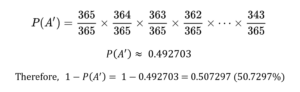
Let’s denote P(A′) as the probability that no two people in the room have the same birthday (when we have 23 people).
We need to find 1 – P(A′).
Instead of comparing each person to a fixed date, we compare every pair of individuals, so probabilities rise much faster than expected.
3. The Four Color Theorem
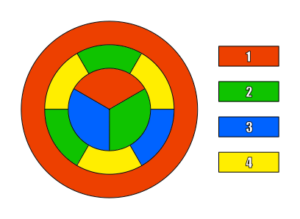
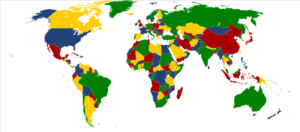
While probability can be surprising, geometry also shares unexpected results. The Four Color Theorem states that any map, regardless of its complexity, can be colored with only four colors so that no adjacent regions share the same color. Although it is simple to understand, the process of proving this theorem was difficult and was finally verified by computer simulations. Furthermore, it marks one of the first major theorems relying on computational verification.
4. Fractals and Nature
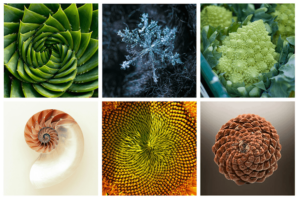
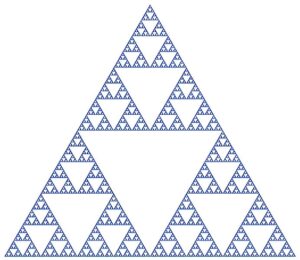
Finally, math has its beauty not only in abstract theories but also in nature. Fractals are patterns that repeat at every scale, so the zoomed-in structures resemble the structure of the whole. These patterns appear in coastlines, trees, and even blood vessels. Fractals show how closely nature and math are woven together. Also, it reveals that complex shapes can be formed using simple patterns.
Together, these examples show that math is all about discovering patterns in the world, whether it’s through randomness, probability, or geometry. So in your daily life, remember that those ordinary moments might be hiding patterns that are surprising to discover.