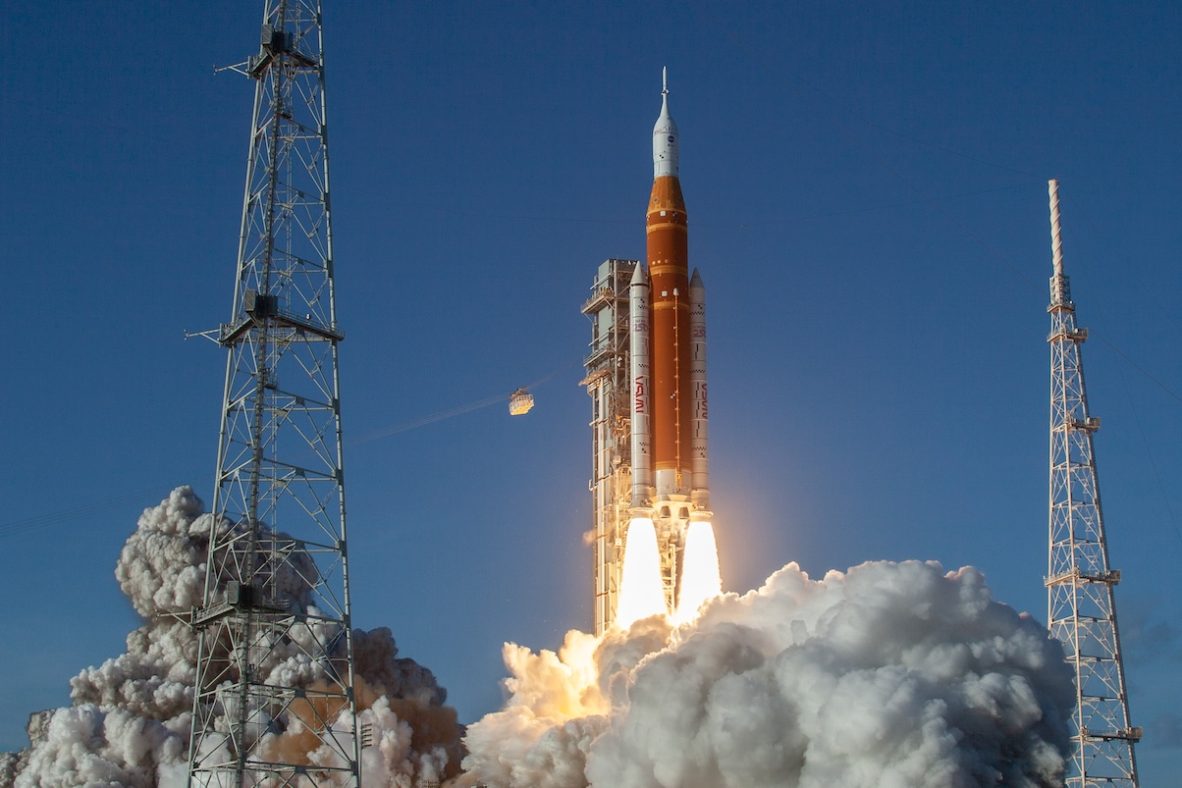
More than half a century after the last human traveled to the Moon in 1972, NASA once again sent astronauts back to space with Artemis II, the first crewed mission of NASA’s Artemis program, on April 1. The eleven-day mission marked a major advancement in space exploration and human effort to bring human presence beyond Earth.
Unlike the Apollo program, a NASA-led human spaceflight project that successfully landed the first humans on the Moon and returned them safely back to Earth, Artemis II did not land on the Moon. Instead, it sent four astronauts on a journey around the Moon and back to Earth to test systems for future exploration.
The Artemis II crew included Reid Wiseman, Victor Glover, Christina Koch, and Jeremy Hansen. This team reflected NASA’s effort to make space exploration more inclusive and representative as it includes the first woman, Christina Koch, and the first Black astronaut, Victor Glover, to travel to the Moon.
The crew traveled on the Orion spacecraft which was launched by NASA’s Space Launch System. After its launch from Earth, Orion orbited briefly before it headed to the Moon. The mission followed a “free-return trajectory,” which means the spacecraft looped around the Moon and naturally returned to Earth by using gravity force. For eleven days, the crew tested life-support systems, communication, navigation, and emergency procedures in space for future lunar exploration.
The most dramatic moment of the mission was Orion’s return to Earth. After the spacecraft reentered the atmosphere at extremely high speeds, it deployed parachutes before splashing down safely in the Pacific Ocean. Recovery teams then retrieved both the capsule and the astronauts from the water. This successful landing proved NASA’s ability to safely bring astronauts back from deep space, which is an important requirement for future Moon missions.
Artemis II will contribute to Artemis III, which is planned to land astronauts on the Moon’s surface for the first time since 1972. Artemis II served as a full-scale test of the spacecraft, crew operations, communication systems, and reentry procedures needed before astronauts can safely return to the Moon. The mission also provided valuable information about how astronauts perform during long deep-space missions and how mission control teams manage operations beyond Earth’s orbit. Also, it will support long-term exploration through projects like the Lunar Gateway, a space station that will orbit the Moon and serve as a base for future missions.
As interest in space exploration continues to grow around the world, Artemis II represents more than just a journey around the Moon. It demonstrated new technological capabilities, enhanced international cooperation, and prepared humanity for future lunar exploration. Hopefully, Artemis III will take humanity a step forward into space discovery just like Artemis II.